Less Ego, More You
Loosening the ego’s grip and reconnecting with the deeper, more expansive you, through reflective guidance and 1:1 shared inquiry with Amelia Black.
About Me
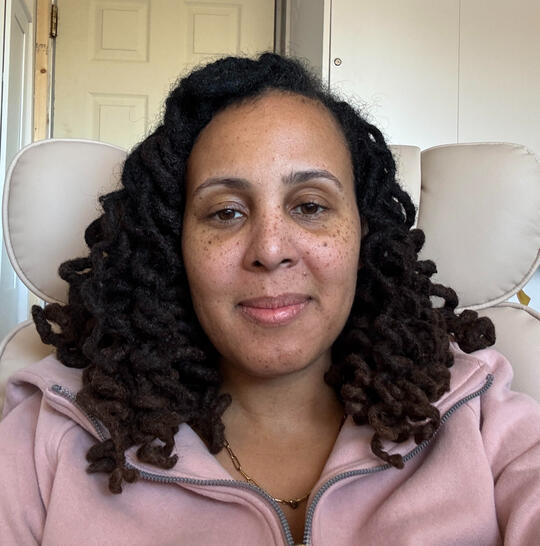
I was trained as a therapist and spent many years in that work. Over time, I developed a strength in understanding people — not just their personality, but their background, their conditioning, and the patterns that shaped them. Deep listening and connecting with the person in front of me was always my strength while on that career path.Over the years I have come to believe so much of our suffering comes from identifying with the ego — those conditioned thought patterns and the sense of “who I think I am.” That identification pulls us away from the deeper you, the one that is steady and alive beneath everything. My work is about meeting people exactly where they are on the journey of loosening that identification and reconnecting with that inner being.Along my own journey, like for so many of us, it was the long and winding moments of greatest suffering, forced upon me quite jarringly and against my will, that directed me towards the insights that ultimately allowed me to manifest my deepest joy. I’ve come to believe that most of our suffering arises from identifying with the ego — the conditioned thought patterns and the familiar sense of “who I think I am.” That identification pulls us away from the deeper self, the presence that is steady, quiet, and fully alive beneath it all. My work is about meeting people exactly where they are as they begin to loosen that identification and reconnect with that inner being.What happens when we do that? In my own life, I’ve seen that without tending to this inner shift, some level of struggle or dissatisfaction tends to persist. But when we begin to reconnect with that deeper self, something opens — a sense of ease, joy, and expansion. I’ve been influenced by many traditions and teachers that point in this same direction — from the tenets of Buddhism, to the insights of teachers like Eckhart Tolle, Alan Watts, and Carl Jung. To me, the common thread that rings true in all these traditions is the invitation to step out of our habitual mind patterns and return to a deeper, truer self — one that is aligned with the larger consciousness of the universe.My Approach to Coaching:
I try to be the nonjudgmental listener and guide that would have been helpful to me on my own path. The most valuable lesson I took from my career in counseling was the idea that I am most useful when I serve as a mirror , reflecting back to you what you truly want to move toward — and that insight is a guiding principle of my coaching practice. My role is to understand you: your background, your conditioning, what concepts speak loudest to you, and what areas of growth you are on the edges of right now and can be pointed towards.You may see me on social media being playful and sharing different lenses of my personal expression. I love that side of myself, and I enjoy sharing it. However, in sessions, I never want my expression of my energy or personality to distract from you expressing yourself. Thus, when I step into my role as a coach, I present a side of myself that is intentionally less expressive, and I create a listening space that is about you, not me. As we get to know each other more, I may share more of my personal expression if it genuinely serves your process — but my instinct is to be neutral, open, and fully attuned. I already know me. You’re here to find more of you, and my job is to create the space for that process to unfold.My intention is always to minimize my voice and amplify the deeper voice within you — the one beneath conditioning and egoic noise. I listen closely for what is already alive in you: the questions you’re circling, the ideas that resonate, the edges you’re sensing but may not yet know how to move toward.If you already have a sense of the concepts or themes that resonate, I support you in deepening your understanding and integration. And if what feels most supportive is direction, guidance, or suggestions about where to place your attention based on where you are, we move in that direction together.How This Work Increases Joy:
Most people — myself included — are drawn to this work when something shakes their foundation. This is often through the realization that everything you’ve built in pursuit of happiness still isn’t bringing the peace or fulfillment you’ve longed for. We start to see that no amount of external accomplishment, success, or “getting it right” can give us the lasting ease we seek.Life invites us (typically through the unwelcome methodology of causing us pain) to confront a deeper truth: real joy has to arise from within, not from the constantly shifting and uncontrollable external world. This work helps you turn toward that inner source — the only place where steady, genuine joy can truly take root.One of the first benefits you may notice as you embrace this path is that everyday life starts to feel more beautiful. Instead of your mind insisting that happiness depends on certain conditions, you begin to realize that joy is available at any moment — as long as the ego isn’t pulling you away from it.There’s also a deeper spiritual shift. As you reconnect with the real you — the being within — you start aligning more naturally with the flow of life. From there you’ll probably notice that when you’re aligned with that deeper place, the universe tends to open doors and unfold in ways more beautiful that you could have ever planned or forced.And while life will always include pain — because being human includes everything — you gain the capacity to stay connected to that deeper, fundamentally-joyful you even during the hard moments. You also begin to experience more of that beautiful, surprising, synchronistic unfolding that life offers when you’re guided from the deeper you rather than by the ego.Why Lessen your Ego? :
The word ego is used in many different ways across psychology and spirituality, but the essence is fairly consistent: the ego is the conceptual you — the identity made of thoughts, roles, stories, and conditioned patterns. It’s the version of yourself that your mind creates and then believes in.Eastern philosophies and many spiritual teachers have pointed to this idea for centuries: there is the “you” made of mental constructions, and there is the deeper you — the expansive, aware presence underneath those constructions.My work focuses on helping you recognize that the self you think you are is not the same as the one who is actually aware. Your “identity” is simply a set of mind patterns, and those patterns can change. You see this every time life reshapes you: you may think of yourself as a partner, an athlete, a professional — until something shifts, the role falls away, and a new identity emerges.These identities aren’t wrong; they’re simply not the essence of who you are. The suffering comes when you become over-identified with them — when you feel you must live up to the expectations tied to a label. This limits your expression and constricts the natural fluidity of who you can be.In reality, there are countless versions of you within you, and the most authentic parts of yourself often appear when you step outside those fixed expectations. You’ve probably felt this — an easy example is the contrast between your “work self” and your more natural self outside of it.My intention is to help you loosen your identification with the constructed self so you can choose your expression, rather than feel confined by it. When you reconnect with the deeper self — the unfiltered consciousness beneath the mind patterns — your creativity, clarity, intuition, and natural joy begin to flow more freely.From that place, the qualities you love in yourself (and recognize in others) start to shine through, and the things that once caused suffering lose much of their power. You’re no longer living from the ego; you’re living from the real you.